How Many Fire Extinguishers Does an EU Workplace Need?
How many fire extinguishers does a workplace need in the EU? Use risk areas, EN 3-7 ratings, and quote inputs to specify stock.
By Mattias EkstrandHead of Product and Trade SupplyFire protection engineer with fourteen years specifying fire safety equipment for EU trade buyers and procurement teams.
A workplace does not need “one extinguisher per room” by default. The count should come from a fire risk assessment, the national rules for the installation country, the fire classes present, travel routes, and the extinguisher ratings selected.
We supply portable extinguishers to B2B buyers, so our job starts after the buyer has a building type, target market, and risk profile. From there, we help turn the site requirement into orderable SKUs, documentation checks, Incoterm choices, and a quotation.
How many fire extinguishers does an EU workplace need?
There is no single EU-wide number for every workplace. The practical count is calculated from the fire risk assessment, national installation rules, building layout, fire classes, extinguisher ratings, and travel distance to each unit.
Council Directive 89/654/EEC Annex I, point 5.1 says workplaces must be equipped with appropriate fire-fighting equipment depending on the dimensions and use of the buildings, the equipment they contain, the physical and chemical properties of substances present, and the maximum potential number of people. That sentence is the right starting point for procurement: the count is tied to the site, not only to headcount.
For sourcing, we separate the job into four checks.
First, count base fire cover by floor or fire compartment. Offices, storage areas, workshops, plant rooms, retail back-of-house areas, and mezzanines may need separate positions because a person cannot always reach an extinguisher quickly through doors, stairs, locked areas, or process zones.
Second, identify special hazards. A kitchenette with cooking oils is not the same risk as a server cabinet. A paint store is not the same as a meeting room. If the hazard changes, the extinguisher type often changes too.
Third, choose ratings before counting units. A higher-rated extinguisher may cover a different requirement than a compact unit, but it may also be heavier, slower to handle, or unsuitable for a corridor where staff need a smaller device.
Fourth, add spare and service stock separately. The installed count is the number placed at risk points. Wholesale order quantity may also include installer stock, swap units for maintenance, trial samples, or branch replenishment.
If you are still building the SKU shortlist, start with our portable fire extinguishers range and send us the target country, workplace type, and expected order profile through our contact page.
Which extinguisher types should be counted by risk area?
Count general cover and special-hazard cover separately. A corridor extinguisher may form part of the base provision, but it should not be assumed to cover a kitchen, electrical room, workshop bay, or lithium-ion charging point unless the risk assessment and local rules allow it.
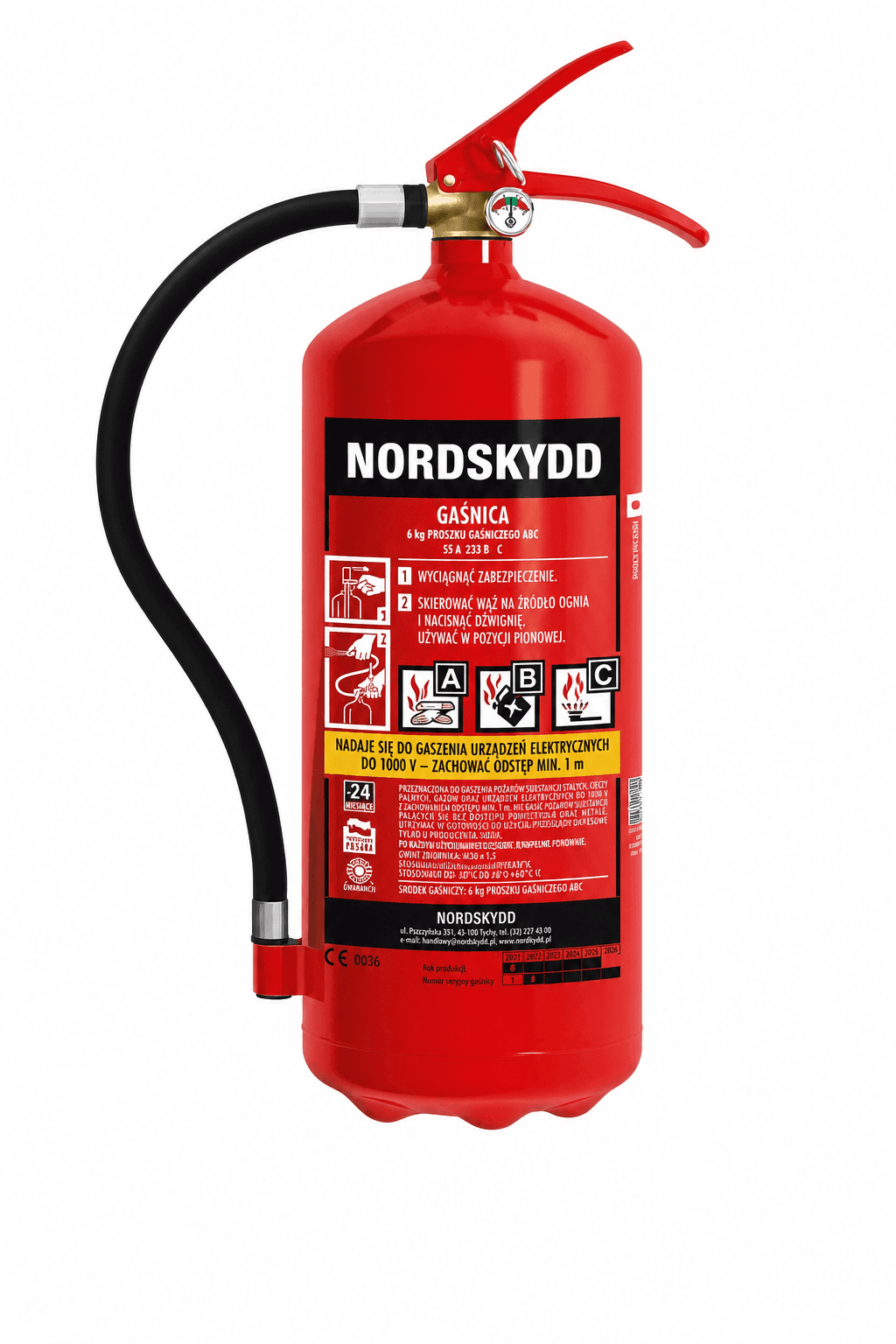
For general commercial cover, buyers often specify ABC powder because it covers Class A, B, and C fire ratings in the product marking. Our 6 kg ABC powder extinguisher is rated 55A 233B C under EN 3-7, operates from -30 °C to +60 °C, includes a metal hook wall hanger, and is manufactured in Poland. That makes it a common candidate for workshops, plant areas, garages, and mixed-risk commercial spaces where powder residue is acceptable.
Related equipment
ABC Powder Fire Extinguisher, 6 kg
Stored-pressure 6 kg ABC powder extinguisher rated 55A 233B C, supplied with a wall hanger for boiler rooms, garages, workshops, plant areas, and general commercial applications.
CE · EN 3-7 · CNBOP-PIB · ISO 9001
View specificationsFor kitchens, staff rooms, canteens, or areas where cooking fats are present, ABF liquid may be the better stock line. Our 6 L ABF liquid extinguisher is rated 21A 233B 40F under EN 3-7 and operates from +5 °C to +60 °C. The F rating is the key point here: do not replace that requirement with a general ABC unit unless the local fire plan permits it.
For electrical cabinets, IT rooms, or electronics bays, buyers often want CO2 because it avoids powder residue. Our 2 kg CO2 extinguisher with UDT permit is rated 34B under EN 3-7, operates from -30 °C to +60 °C, and is supplied with a wall hanger and strap. CO2 should still be positioned by a competent person because enclosure size, ventilation, and user safety matter.
Lithium-ion risks need their own review. A warehouse with charging e-bikes, cordless tools, scanners, or power packs should not be treated as a standard office simply because the floor area is small. The sourcing question becomes: which risk points need ordinary Class A or B cover, and which points need a battery-focused product selected by the safety designer?
What spacing and location checks affect the extinguisher count?
The count increases when people cannot reach a suitable extinguisher without delay, obstruction, or unsafe travel. Doors, split levels, outdoor yards, locked plant rooms, long racking aisles, and process barriers all change the installed number.
In procurement, we ask buyers to mark extinguisher positions on a floor plan before fixing quantity. A simple spreadsheet count can understate the real need if it ignores movement through the workplace. One extinguisher beside reception may be visible, but it may not be a practical first-aid fire point for a rear workshop, a mezzanine office, or a fenced compressor room.
Placement should also consider operating temperature. Powder units in our range can be suitable for colder unheated areas where the stated range is -30 °C to +60 °C. Several liquid and foam units are stated at +5 °C to +60 °C, while our 6 L fluorine-free AB foam model is stated at 0 °C to +60 °C. If a workplace has outdoor stores, loading docks, cold rooms, or unheated garages, temperature can change the SKU choice before it changes the count.
Visibility is another practical issue. An extinguisher behind a door, curtain, pallet stack, or cabinet is a weak position even if the numeric count looks correct. For marked locations, our 150 x 150 mm fire extinguisher sign is a hard PVC adhesive-backed F01 sign to PN-EN ISO 7010, manufactured in Poland. Signs do not replace extinguishers, but they help the installed count remain usable after the building is occupied.
What specification should be written into a workplace extinguisher order?
Write the order around the exact extinguisher type, rating, standard, mounting format, operating temperature, warranty, article number, Incoterm, and destination. If the tender asks for EN 3-7, do not substitute supplementary domestic equipment unless the buyer has approved that change in writing.
For workplace portable extinguishers, the key product standard in our range is EN 3-7 where stated on the SKU. Several models also carry CNBOP-PIB approval in the product facts, but that approval is SKU-specific. It should not be copied from one model to another in a tender file.
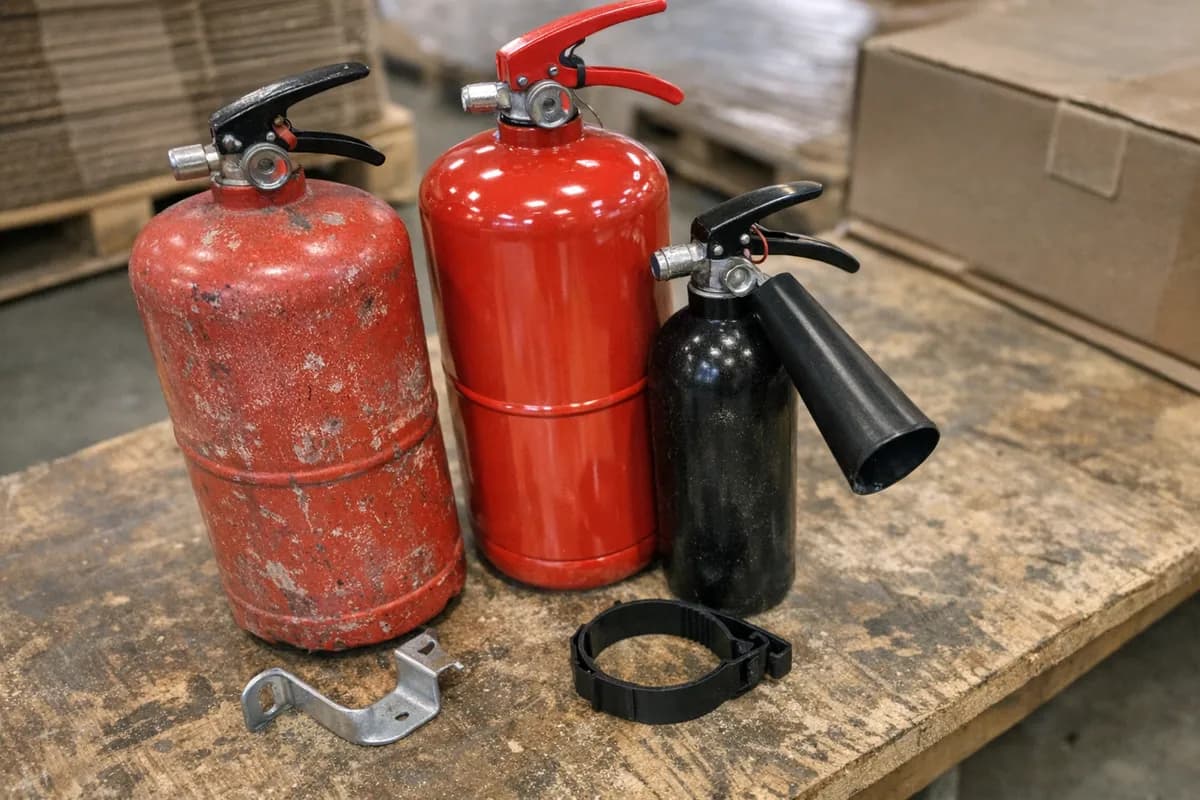
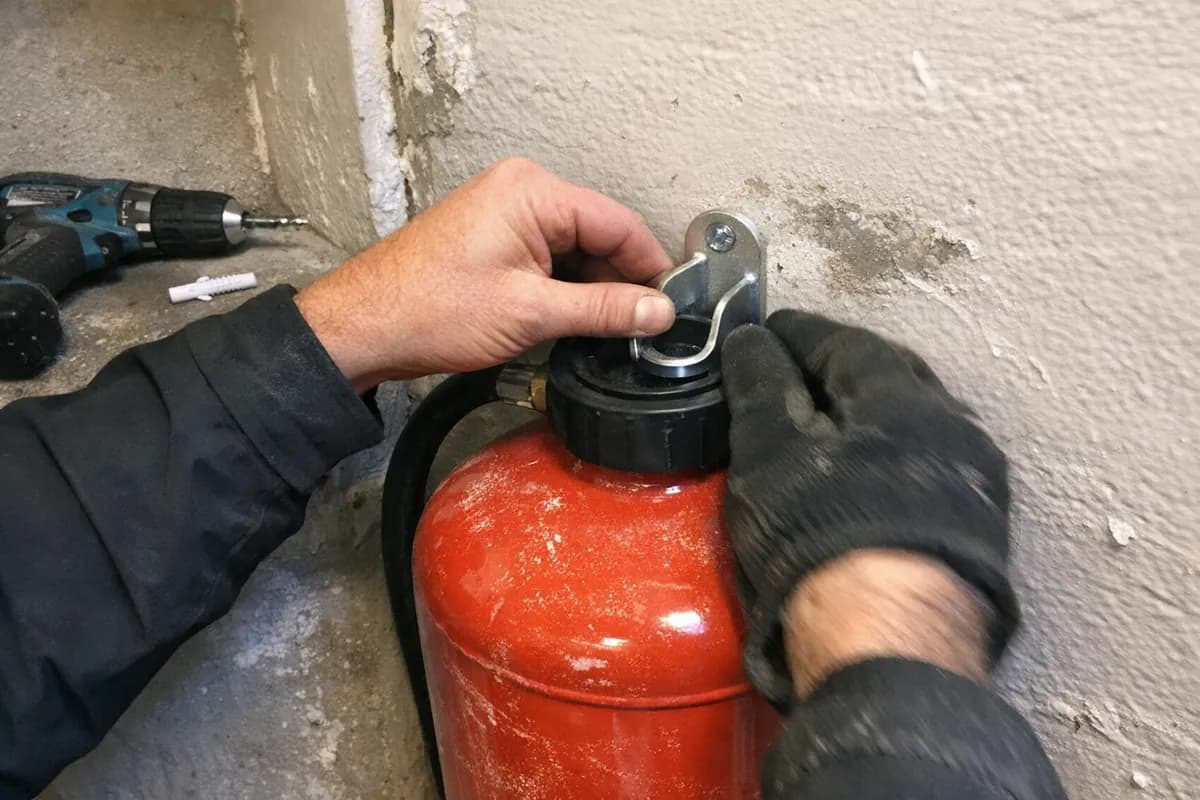
Mounting should be specified because the installed count depends on usable positions. A metal hook wall hanger, metal basket hanger, plastic vehicle hanger, or disc wall hanger with strap can change how the installer fixes the unit. If your reseller or project customer needs a specific bracket style, define it at quotation stage rather than after goods arrive.
Electrical safety wording also needs care. Several of our extinguisher facts state live equipment safety to 1000 V, in some cases with a 1 m minimum distance. That field is useful for office and workshop procurement files, but it does not make every extinguisher interchangeable around electrical risks.
For ERP and customs setup, our extinguisher product facts use HS code 8424.10. For commercial terms, we quote extinguisher orders under EXW, FCA, or DAP. Put the Incoterm and named place into the purchase request early, because the same SKU mix can price differently depending on who controls transport.
What is the MOQ and price context for workplace extinguisher supply?
Our published product facts do not set a fixed MOQ for workplace extinguisher lines. We quote after the article numbers, quantities, destination, and preferred EXW, FCA, or DAP term are confirmed.
Price is driven by the extinguisher model, cylinder size, agent type, rating, certification set, hanger, packing requirement, order volume, and delivery boundary. A 6 kg ABC powder unit, a 6 L ABF liquid unit, and a 2 kg CO2 unit do not share the same cost base or freight profile. Gross weight also matters for pallet planning and delivery economics.
There is no terminal market benchmark for finished portable extinguishers in the way there is for some raw commodities. A workable quote is built from the exact SKU mix, current production and transport conditions, documentation requirement, and Incoterm. We do not publish a generic workplace extinguisher price because it would be misleading for buyers comparing different ratings and agents.
For a current quotation, send the floor-plan count or branch replenishment list through our contact page, including article numbers where known, target country, delivery postcode, and whether you want EXW, FCA, or DAP.
How should a buyer move from count to order?
Move in this order: risk assessment, extinguisher type, rating, position count, document check, Incoterm, then purchase order. That sequence prevents the common sourcing error where the buyer orders a quantity before the building layout or product standard has been checked.
A practical order file should include the site type, installation country, floor or zone count, required fire classes, preferred extinguisher capacity, required approvals, mounting requirement, language or label expectations, and delivery term. If the buyer is a distributor, add the resale channel because domestic supplementary equipment and workplace EN 3-7 equipment should not be mixed without a clear reason.
When the count comes from a fire consultant or installer, keep their schedule attached to the purchase order. We can then quote against named SKUs rather than a generic line such as “workplace extinguishers.” That gives procurement, warehouse, and the end customer the same reference point: the right number of extinguishers, in the right types, for the stated workplace risk.