EU PFAS Ban for Fire Extinguishers: 2026 Replacement Guide
This EU PFAS ban for fire extinguishers guide helps buyers track 2026 deadlines and specify fluorine-free replacement stock.
By Mattias EkstrandHead of Product and Trade SupplyFire protection engineer with fourteen years specifying fire safety equipment for EU trade buyers and procurement teams.
EU buyers are replacing AFFF-labelled portable extinguishers because PFAS rules are moving from substance bans into foam procurement. The 2026 date is not a blanket ban on every fire extinguisher. It is a compliance trigger for certain PFHxA-containing firefighting foams used for training and testing, and it should push procurement teams to sort stock by agent before the next tender.
We supply portable extinguishers and replacement options for B2B buyers under EXW, FCA, or DAP. For a PFAS replacement project, we start with the agent label, fire rating, EN 3-7 status, and destination market, then quote the selected SKUs rather than treating “foam extinguisher” as one product.
Is the EU PFAS ban for fire extinguishers really a 2026 ban?
No, not as a blanket ban on all portable fire extinguishers. The 2026 deadline buyers are tracking comes from PFHxA restrictions in firefighting foams, while older PFAS controls and the wider EU PFAS restriction proposal sit on separate legal tracks.
Commission Regulation (EU) 2024/2462, published by the European Commission, amends Annex XVII to REACH and sets PFHxA limits at 25 ppb for the sum of PFHxA and its salts and 1,000 ppb for the sum of PFHxA-related substances. Under that Regulation, PFHxA-containing firefighting foams and firefighting foam concentrates above those limits cannot be placed on the market or used for training and testing from 10 April 2026, except functional testing where releases are contained.
That matters to extinguisher buyers because many legacy portable foam units are described as AFFF, ABF with AFFF cartridge, or film-forming foam. AFFF is not itself a legal concentration result. It is a label that should trigger a compliance check. The supplier or manufacturer needs to state whether the agent falls within a restricted PFAS entry, or the buyer should specify a fluorine-free or non-foam alternative.
The broad “universal PFAS” restriction is different. ECHA published the Annex XV restriction proposal prepared by authorities from Denmark, Germany, the Netherlands, Norway, and Sweden in 2023, but that proposal is still going through the EU restriction process. Buyers should not treat it as the source of a fixed 2026 extinguisher deadline.
Which PFAS deadlines should procurement teams put in the sourcing file?
Put three checks in the file: old POPs restrictions, the 10 April 2026 PFHxA training and testing deadline, and any later tender date set by the end customer. The legal deadline is only part of the purchasing decision, because distributors and public buyers often move earlier to avoid mixed stock.
Regulation (EU) 2019/1021 on persistent organic pollutants, published by the European Parliament and the Council, controls substances such as PFOS, PFOA, and PFHxS through Annex I entries. Commission Delegated Regulation (EU) 2020/784, published by the European Commission, added PFOA, its salts, and PFOA-related compounds to Annex I and set 4 July 2025 as the end date for certain remaining uses of PFOA-containing firefighting foam already installed in systems.
For the 2026 procurement file, the practical wording is simple: no AFFF-labelled portable extinguisher should be bought as replacement stock unless the supplier provides a declaration that the agent is outside the relevant restricted PFAS thresholds. If the project includes staff training, demonstrations, extinguisher servicing, or test discharge, the 10 April 2026 PFHxA date needs a written decision before the stock is used.
We recommend that buyers sort the installed base into four groups:
- AFFF-labelled foam or ABF units with an AFFF cartridge
- Fluorine-free foam units
- Water, water-mist, CO2, and dry powder units
- Unknown agent or relabelled private-label units
The fourth group should not be rolled into the next order by description alone. Ask for the exact agent name, standard status, fire rating, cylinder size, and compliance declaration before comparing price.
Which extinguisher types should replace AFFF foam?
For a like-for-like foam replacement, specify fluorine-free AB foam where the fire class and tender wording allow it. Where foam is not required, water-mist, CO2, or ABC powder may be a cleaner procurement route because the extinguishing medium is not an AFFF-labelled foam.
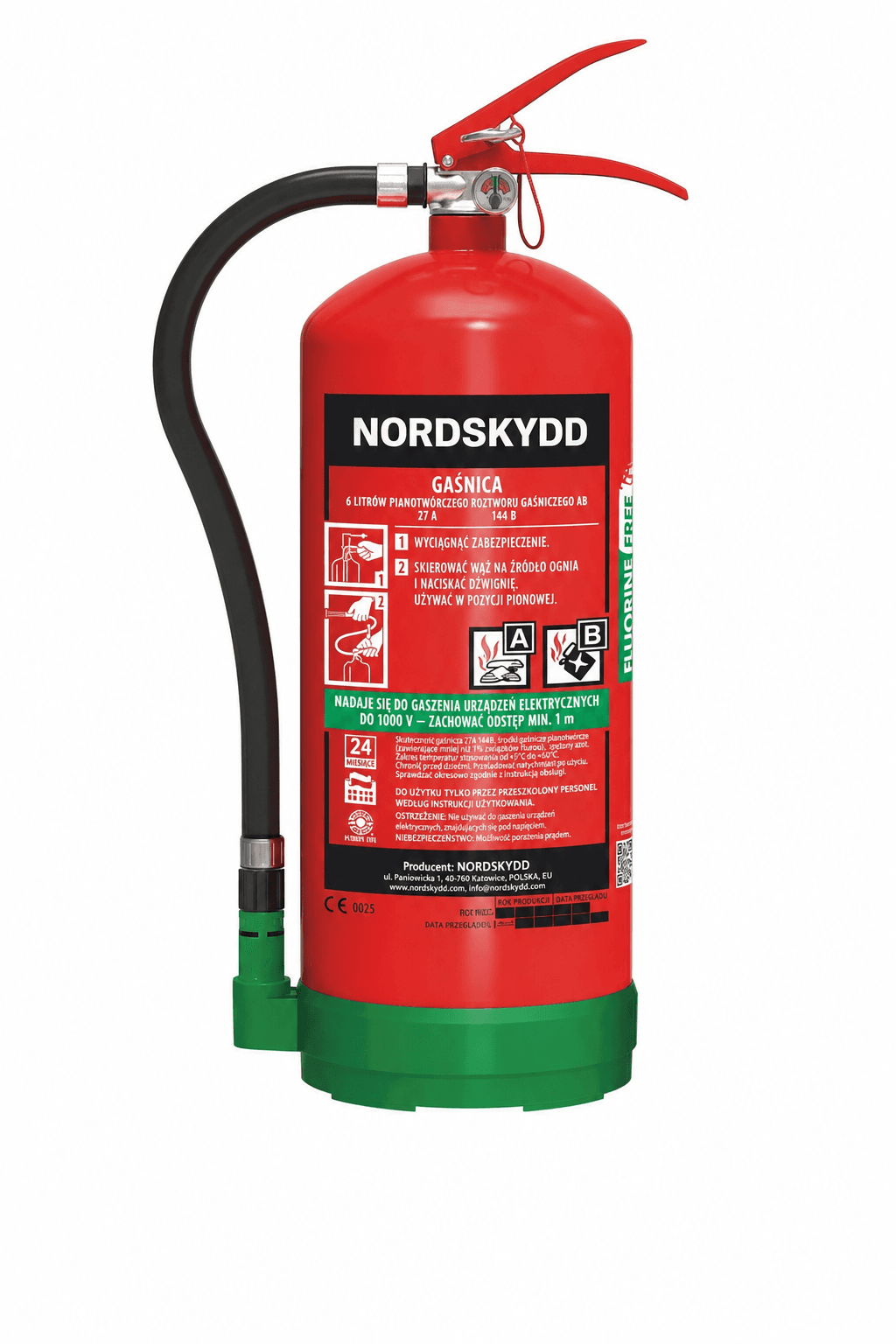
Our direct fluorine-free foam options are the 6 L fluorine-free foam extinguisher and the 9 L AB fluorine-free extinguisher. Both use FFX150 fluorine-free AB foam solution in the published product facts. They are replacement candidates for buyers who still need A and B fire ratings but want to remove AFFF-labelled agent from the purchase order.
Related equipment
6 L fluorine-free foam extinguisher
Stored-pressure 6 L fluorine-free AB liquid cylinder rated 27A 144B under EN 3-7 with CNBOP-PIB approval, for offices, boiler rooms, and workshops where a mid-size foam portable is needed without PFAS in the agent.
CE · EN 3-7 · CNBOP-PIB · ISO 9001
View specifications| Replacement option | Published extinguishing medium | Fire rating | Standard status | Operating temperature |
|---|---|---|---|---|
| 6 L AB fluorine-free, article NV-FE-L6F | 6 L FFX150 fluorine-free AB foam solution | 27A 144B | EN 3-7, CNBOP-PIB approved | 0 °C to +60 °C |
| 9 L AB fluorine-free, article NV-FE-L9F | 9 L FFX150 fluorine-free AB foam solution | 34A 183B | EN 3-7, CNBOP-PIB approved | 0 °C to +60 °C |
| 6 L water-mist, article NV-FE-WM6 | Demineralized water | 13A 40F | EN 3-7 | +5 °C to +60 °C |
| 6 kg ABC powder, article NV-FE-106 | ABC dry powder | 55A 233B C | EN 3-7 | -30 °C to +60 °C |
| 5 kg CO2, article NV-FE-CO5U | CO2 | 89B | EN 3-7, CNBOP-PIB approved, UDT permit | -30 °C to +60 °C |
The table is not a universal substitution matrix. A 6 kg ABC powder extinguisher gives C-class cover, but it leaves powder residue. A CO2 extinguisher has a B fire rating and is often selected where residue matters, but it is not an A-class foam replacement. A 6 L water-mist extinguisher can be relevant where water-based cover is accepted and a foam agent is not wanted.
If your tender requires “foam, fluorine-free, EN 3-7,” start with the two FFX150 AB options. If the tender says only “portable extinguisher for offices,” step back and compare fire class, residue, operating temperature, and mounting before choosing foam.
What specifications should go on the PFAS replacement RFQ?
The RFQ should state the old agent type, required fire classes, minimum fire rating, EN 3-7 requirement, mounting format, Incoterm, delivery country, and whether a fluorine-free declaration is mandatory. Without those fields, suppliers may quote a cheaper AFFF-labelled product that does not solve the compliance problem.
For the 6 L fluorine-free AB extinguisher, our published specification is: article NV-FE-L6F, 6 L capacity, 6 L FFX150 fluorine-free AB foam solution, fire rating 27A 144B, EN 3-7 with CNBOP-PIB approval, CE, EN 3-7, CNBOP-PIB, and ISO 9001 certifications, operating temperature 0 °C to +60 °C, live equipment safety to 1000 V, 502 mm height, 160 mm cylinder diameter, 9.4 kg gross weight, red cylinder with green base and nozzle, silver metal hook wall hanger, 2-year warranty from date of manufacture, manufactured in Poland, HS code 8424.10, and EXW, FCA, or DAP Incoterms.
For the 9 L version, the main sourcing difference is capacity and rating: it is a larger AB fluorine-free unit rated 34A 183B. That makes it a candidate where the buyer wants a larger portable foam unit for warehouses, public buildings, or project specifications that call for higher A-class cover.
Do not write “PFAS-free extinguisher” without defining the evidence required. Better wording is: “Extinguishing agent must be fluorine-free, with supplier declaration and product datasheet matching the quoted article number.” That ties the claim to the SKU, not to a product family.
Buyers who are still comparing foam, powder, CO2, and water-mist can start from our portable fire extinguishers range, then send the shortlist through our contact page for a current quotation and document check.
What is the MOQ and price context for PFAS replacement extinguishers?
Our published product facts do not set a fixed MOQ for these extinguisher lines. We quote after the SKU mix, order volume, Incoterm, destination, and documentation requirement are confirmed.
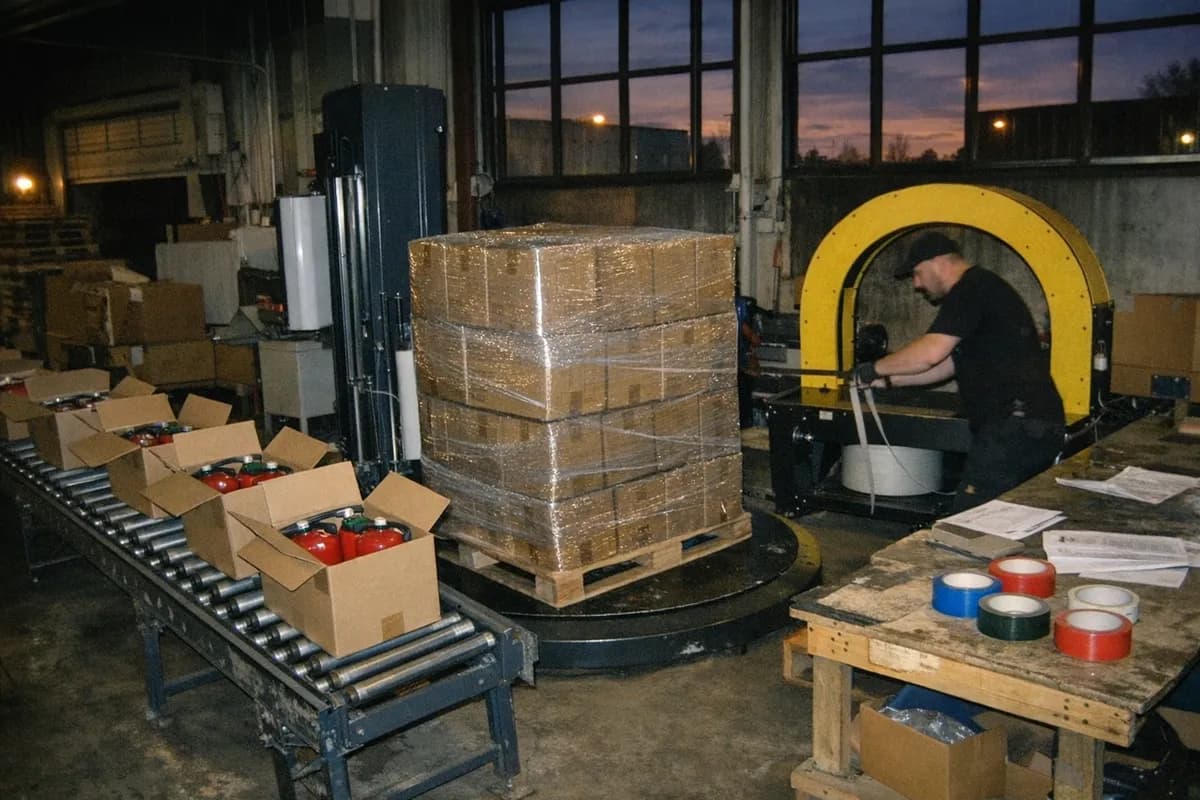
Price is driven by extinguisher type, cylinder size, agent, certification set, hanger format, packing requirement, and freight boundary. A fluorine-free foam unit does not price the same way as a dry powder cylinder or a CO2 extinguisher with a UDT permit. A 9 L foam unit also changes pallet weight and handling compared with a 6 L unit.
Incoterm choice changes the quoted scope. Under EXW, the buyer controls collection from the named place. Under FCA, the handover point is agreed in the order. Under DAP, we need the delivery address, unloading conditions, and delivery booking rules before giving a delivered price.
For transport, charged portable extinguishers may require an ADR decision before collection. If your purchasing team is replacing AFFF stock at several sites, ask the forwarder early whether it will handle the shipment under the applicable dangerous goods route. We cover that process in our EU ADR shipping guide for fire extinguishers.
How should an EU buyer order replacement stock before 2026?
Run the project in this order: audit, classify, specify, document, quote, then deliver. That sequence prevents the common error of buying “foam extinguishers” again without proving that the agent has changed.
Start with an installed-base export from your ERP or service contractor. Mark every unit where the agent description includes AFFF, ABF with AFFF cartridge, film-forming foam, unknown foam, or private-label foam. Then decide which locations truly need foam performance and which can move to powder, CO2, or water-mist.
Next, write a short replacement rule for each location type. Example: offices may accept fluorine-free AB foam or water-mist depending on the fire risk assessment. Workshops may need A and B cover with an EN 3-7 rating. Electrical rooms may call for CO2 where powder residue is not acceptable. Keep the rule linked to fire class and rating, not only to PFAS policy.
Before placing the order, check that the quotation names the exact article numbers, Incoterm, HS code, warranty period, and certification set. For fluorine-free foam, attach the supplier declaration or datasheet to the order file. For AFFF-labelled legacy products, keep disposal and servicing records separate from new stock records so the compliance trail is clear.
A replacement programme should finish with fewer SKUs, clearer agent wording, and no ambiguous “foam” descriptions in purchasing data. Send us your old SKU list, required fire ratings, destination country, and preferred Incoterm via our contact page, and we will quote against the exact replacement articles rather than a generic PFAS note.