European Commercial Vehicle Fire Safety-Kit Rules
Fire extinguisher and safety-kit requirements for commercial vehicles in Europe vary by route, vehicle use and ADR status.
By Mattias EkstrandHead of Product and Trade SupplyFire protection engineer with fourteen years specifying fire safety equipment for EU trade buyers and procurement teams.
Commercial vehicle safety equipment in Europe is not a single SKU decision. A buyer has to separate ordinary road equipment rules from ADR dangerous-goods rules, then specify the extinguisher rating, first-aid kit standard, warning equipment and mounting format that match the vehicle’s use.
We supply vehicle fire extinguishers and safety-kit items for B2B buyers under EXW, FCA or DAP. This guide sets out how we evaluate fire extinguisher and safety-kit requirements for commercial vehicles in Europe before quoting a fleet, importer or motor-trade order.
What rules apply to commercial vehicle safety kits in Europe?
There is no single Europe-wide safety-kit list that covers every commercial vehicle in every country. We treat the requirement as three checks: national road equipment rules, customer or fleet policy, and ADR dangerous-goods rules where applicable.
For ordinary commercial vehicles, national road rules decide whether a vehicle must carry a fire extinguisher, first-aid kit, warning triangle, high-visibility vest or other road equipment. A van registered in one country and operating cross-border can face a different practical checklist from a vehicle used only inside one market. That is why we ask buyers for the registration country, destination market and vehicle type before recommending a stock basket.
ADR is different because it is a formal dangerous-goods transport framework. UNECE publishes ADR, and ADR 8.1.4 requires fire extinguishers for transport units carrying dangerous goods. The same section sets capacity by maximum permissible mass: transport units of 3.5 tonnes or less need a minimum total capacity of 4 kg dry powder, transport units over 3.5 tonnes and up to 7.5 tonnes need 8 kg, and transport units over 7.5 tonnes need 12 kg. ADR 8.1.4 also requires at least one portable extinguisher suitable for engine or cab fires with a minimum capacity of 2 kg dry powder.
That ADR wording matters for sourcing. A 1 kg vehicle extinguisher may suit a national passenger-car or light-fleet kit, but it does not meet the ADR 2 kg cab extinguisher minimum. A BC-rated extinguisher may suit a narrow fleet specification, but ADR refers to extinguishers suitable for fire classes A, B and C. For ADR work, we would steer the buyer toward ABC-rated EN 3-7 units and check the required total capacity before quoting.
Which extinguisher should be specified for a fleet vehicle?
For a standard fleet or motor-trade vehicle kit, specify an EN 3-7 vehicle extinguisher with the rating, bracket and size stated in the RFQ. For ADR vehicles, start from the ADR mass band and use ABC-rated capacity, not a generic “car extinguisher” description.
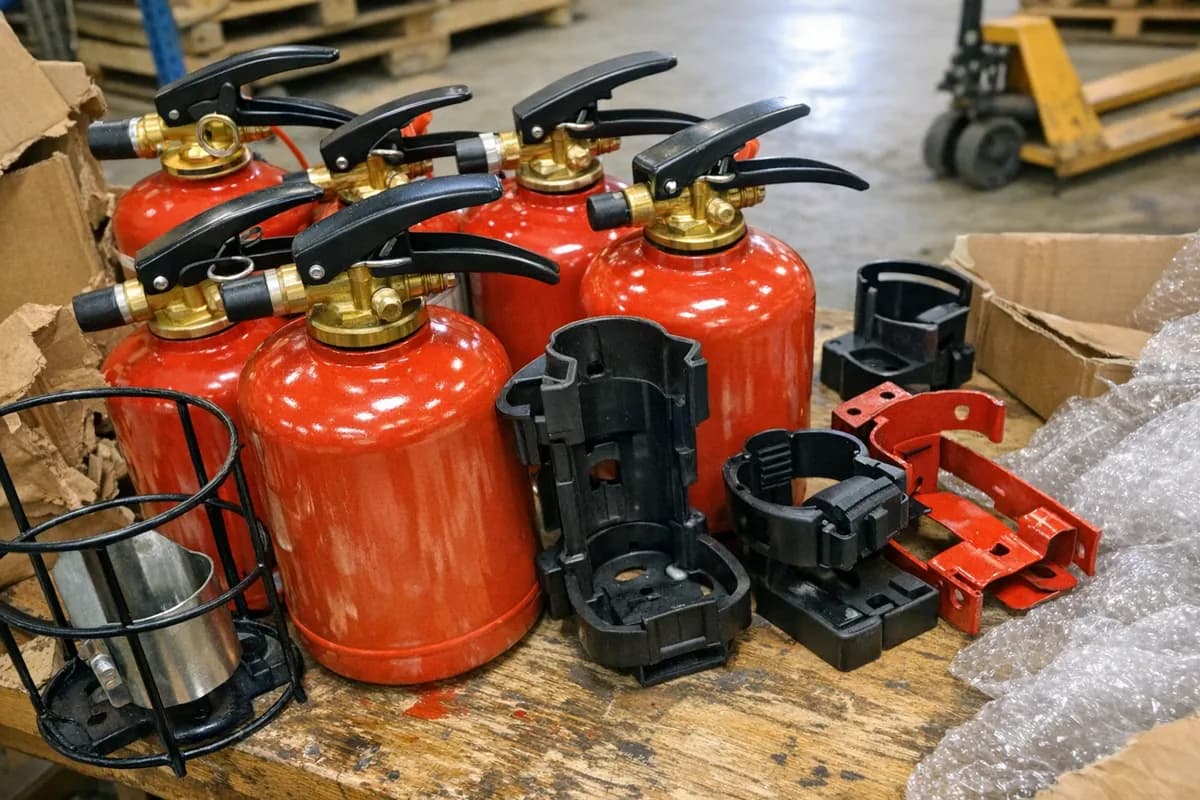
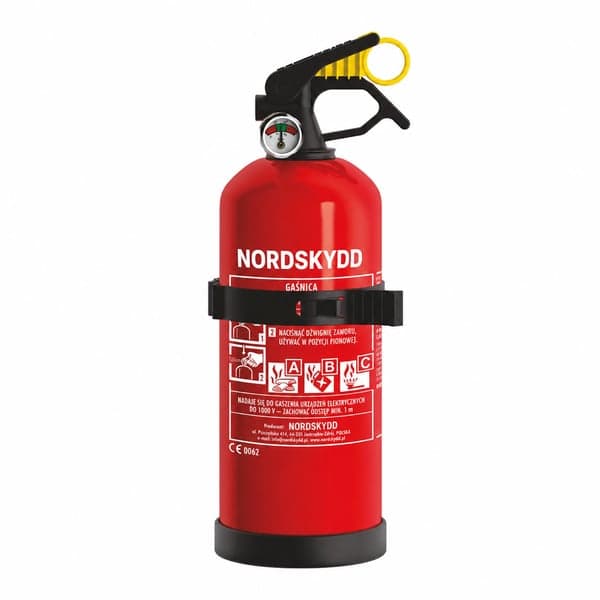
Our 1 kg ABC vehicle extinguisher is rated 8A 34B C, filled with ABC dry powder, certified CE, EN 3-7, CNBOP-PIB and ISO 9001, operates from -30 °C to +60 °C, is electrically safe on live equipment to 1000 V at 1 m minimum, measures 288 mm high by 86 mm cylinder diameter, has a gross weight of 1.7 kg, includes a plastic vehicle hanger, carries a 3-year warranty from date of manufacture, is manufactured in Poland, uses article number NV-FE-1AC, and is quoted under EXW, FCA or DAP with HS code 8424.10.
Related equipment
1 kg ABC vehicle extinguisher
Stored-pressure 1 kg ABC powder cylinder rated 8A 34B C with a plastic vehicle hanger for passenger cars, camper vans, and small boats where a 1.7 kg unit must fit in a footwell or boot.
CE · EN 3-7 · CNBOP-PIB · ISO 9001
View specificationsThat is the compact ABC option for passenger cars, light vans, camper vans and similar vehicle programmes where the buyer wants A, B and C fire-class coverage in a small cylinder. If your tender asks for 2 kg, our 2 kg ABC vehicle-format extinguisher is the closer match because it carries a 13A 89B C rating and is supplied with a metal basket hanger.
The trade-off is space and installed weight. A 1 kg unit is easier to place in a boot or cabin. A 2 kg unit gives a higher rating and aligns better with specifications that name 2 kg as a minimum, but it needs more mounting space and a stronger location plan. For commercial vehicles, bracket choice is not cosmetic. A cylinder that cannot be reached, or that moves loose in the cab, is not a usable safety item.
Do not assume that every vehicle kit extinguisher is suitable for every regulatory purpose. Our BC powder vehicle extinguisher is rated 21B C, so it does not state an A rating. That distinction is important where a rule, fleet policy or ADR requirement names A, B and C suitability.
What safety-kit items should be ordered with the extinguisher?
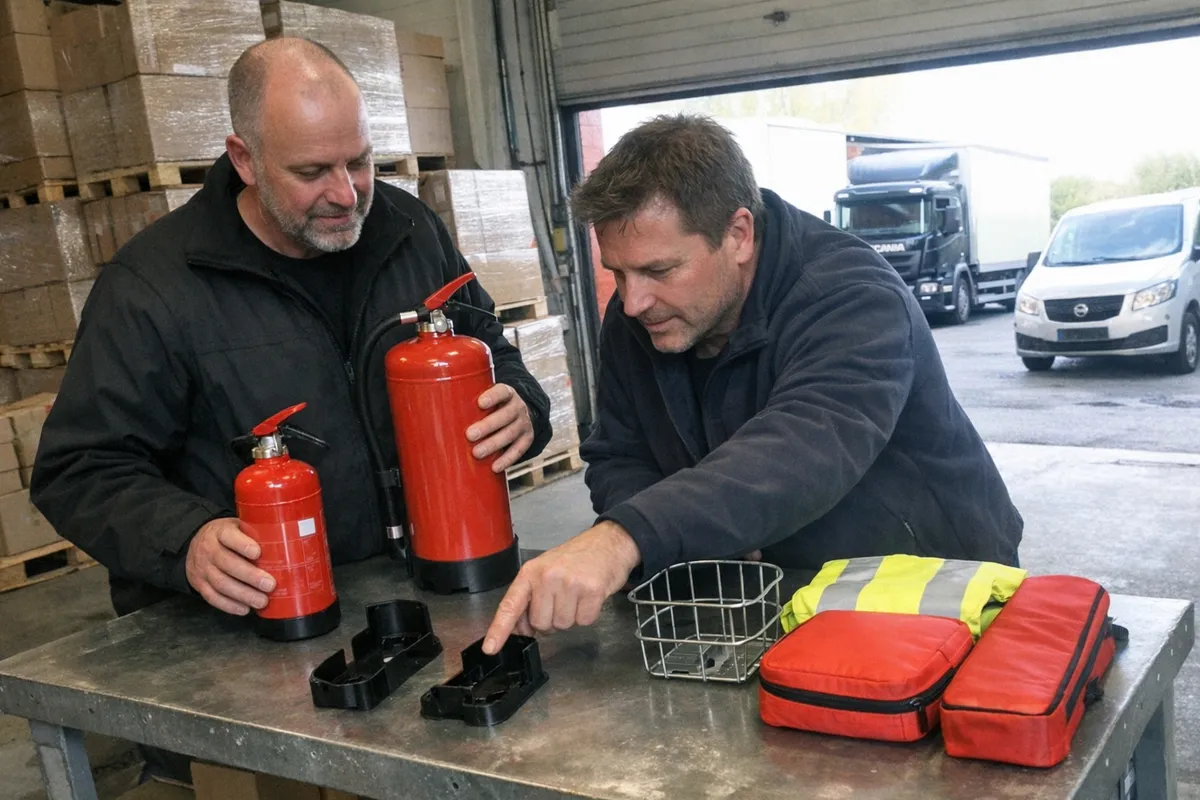
A practical European commercial vehicle kit usually starts with the extinguisher, first-aid kit, warning triangle and high-visibility vest, then adds market-specific items if the operating country requires them. We quote the common items as individual SKUs or as a bundled vehicle safety kit where the specification fits.
Our vehicle safety kit with 1 kg extinguisher contains a GP-1z BC/M 1 kg BC powder extinguisher, plastic vehicle hanger, first-aid kit with DIN 13164:2022 equipment, high-visibility warning vest and warning triangle. It is manufactured in Poland, article number NV-VSK-CAR01, and the stated certifications include CE, EN 3-7, CNBOP-PIB, ISO 9001 and DIN 13164:2022. It is quoted under EXW, FCA or DAP with HS code 8424.10.
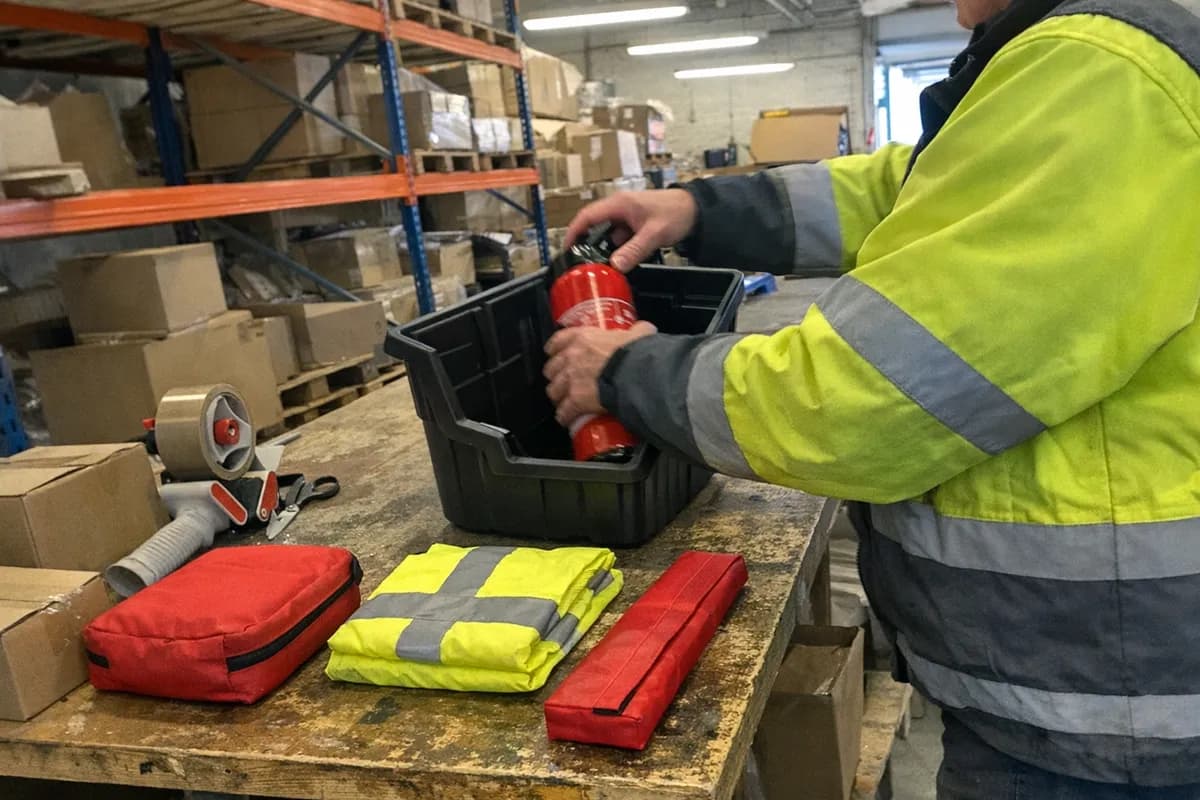
That bundle is useful when a buyer wants one boot-kit SKU for resale, leasing fleets or dealer handover packs. The limitation is the extinguisher rating: it is BC, not ABC. If your vehicle programme requires A-class coverage, we would quote a separate ABC extinguisher line rather than treating the kit as a substitute.
For buyers building their own pack, the vehicle first-aid kit is the medical component to check. It is a red soft pouch to DIN 13164:2022, with stated dimensions of 220 mm wide by 130 mm high by 55 mm deep and gross weight of 0.37 kg. The product facts include disposable masks, disposable gloves, compresses, bandages, plasters, scissors, rescue blanket and a first-aid leaflet. If your resale market needs a specific language leaflet or private label, state that before quotation because it is not implied by the DIN reference.
The compact warning triangle is a separate road accessory with a foldable triangle and red protective case. Its product facts state a gross weight of 0.4 kg and HS code 8708.99. It is not an extinguisher product and should not be placed under the extinguisher customs line in an ERP setup.
What is the minimum order and price context?
Our published product facts do not set a fixed MOQ for vehicle extinguishers or safety kits, so we quote after SKU mix, quantity, Incoterm and destination are confirmed. Price is driven by extinguisher capacity, agent type, certification set, bracket format, kit contents, packing requirement, freight boundary and order volume.
A kit containing a BC extinguisher, vest, warning triangle and DIN first-aid pouch is costed differently from a loose 1 kg ABC extinguisher order. A 2 kg ABC unit changes both the product cost and freight profile compared with a 1 kg unit. If the order includes first-aid kits and warning triangles, the carton plan and customs lines also change.
Incoterm choice affects the price boundary. Under EXW, the buyer controls collection. Under FCA, the handover is to the carrier at the named place. Under DAP, we need the delivery address, unloading conditions and any delivery booking requirement before pricing. We do not publish spot freight or component-cost figures in guides because they become stale quickly.
For a current quote, send the target market, required rating, kit contents, estimated annual volume and destination through our contact page. If you are still choosing between loose SKUs and a bundle, start with our vehicle safety equipment category and send us the shortlist.
Which documents and shipment checks are needed before ordering?
Check documents at SKU level before issuing the purchase order. The important fields are extinguisher standard, fire rating, certificates stated in the product facts, article number, HS code, Incoterm and any dangerous-goods shipment requirement.
For extinguisher conformity, CEN’s EN 3-7 standard covers portable fire extinguishers and is the main standard reference on our vehicle-format extinguisher lines where stated. The certificate set can differ by SKU. Our ABC vehicle extinguisher states CE, EN 3-7, CNBOP-PIB and ISO 9001. The vehicle safety kit lists several certifications because it contains more than one type of item.
For dangerous-goods carriage of the goods themselves, fire extinguishers can require transport checks separate from the vehicle-use requirement. UNECE ADR lists fire extinguishers under UN 1044, and buyers arranging collection should confirm carrier acceptance and paperwork before pickup. We cover that shipment topic separately in our guide to EU ADR shipping requirements for fire extinguishers.
For mixed safety-kit orders, do not force every line into one customs or compliance category. Extinguisher product facts use HS code 8424.10. The standalone first-aid kit uses HS code 3006.50. The warning triangle uses HS code 8708.99. That difference is normal, but it should be visible in the buyer’s import file.
How should a buyer turn requirements into a purchase order?
Start with the rule set, then specify the product. A clear purchase order follows this sequence: country or route requirement, vehicle category, ADR status, extinguisher rating, kit contents, quantity, Incoterm and destination.
For an ordinary fleet, we would first confirm whether the buyer wants a complete boot kit or separate items. If the requirement is a simple dealer handover pack, the bundled kit may be enough. If the requirement names ABC fire-class cover, we separate the extinguisher selection from the kit and quote an ABC vehicle unit.
For an ADR fleet, we do not begin with a retail-style safety kit. We begin with ADR 8.1.4 mass bands, confirm total extinguisher capacity, check that A, B and C suitability is stated, then build the remaining equipment list around the vehicle’s dangerous-goods operation. If the buyer is unsure about extinguisher class terminology, our guide on portable extinguisher types explains A, B, C and other fire classes in procurement terms.
The best RFQ is short but exact: “1 kg ABC vehicle extinguisher, EN 3-7, plastic vehicle hanger, 8A 34B C, FCA or DAP, destination and quantity stated.” For a kit order, add whether the extinguisher may be BC-rated or must be ABC-rated. That one line prevents the common mismatch between a low-cost boot kit and a regulated commercial-vehicle requirement.