European Portable Powder vs Foam vs Water Mist Extinguishers
This powder vs foam vs water mist guide helps buyers specify European portable extinguishers by risk, rating and order route.
By Mattias EkstrandHead of Product and Trade SupplyFire protection engineer with fourteen years specifying fire safety equipment for EU trade buyers and procurement teams.
Selecting between powder, foam and water mist is not a brand preference. It is a specification decision based on fire class, rating, residue tolerance, temperature range, certification requirement, mounting point and freight plan.
We supply B2B portable extinguisher lines from our European range under EXW, FCA or DAP. In this guide, we compare powder vs foam vs water mist extinguishers for buyers building a tender, resale range or project bill of materials. The practical question is simple: which agent gives the correct fire cover without creating the wrong clean-up, compliance or logistics problem?
What is the practical difference between powder, foam and water mist?
Powder gives the broadest class coverage in our range when A, B and C risks must be covered in one extinguisher. Foam and liquid extinguishers are better when the buyer wants A and B cover with less powder residue, while water mist is a targeted choice for A and F risks where demineralized water is acceptable.
CEN’s EN 2 fire classification standard defines Class A for solid materials, Class B for flammable liquids, Class C for flammable gases, Class D for combustible metals, and Class F for cooking oils and fats. Electrical risk is checked separately through the extinguisher’s electrical safety statement, not through an “E” fire class.
For a procurement manager, the first split is usually residue. ABC powder is useful in garages, plant rooms, vehicles, unheated storage and general industrial points where a wide rating matters more than post-discharge cleaning. Foam is usually chosen where a water-based agent is acceptable and the end user wants less contamination than powder. Water mist is chosen when the specification calls for demineralized water and F-rated cooking-fat cover without foam additives.
The second split is temperature. Powder lines in our range can cover colder locations. Foam and water-mist lines have higher minimum operating temperatures, which can rule them out for some unheated outdoor cabinets or winter-exposed warehouses.
If you are building a category range rather than one project order, start with our portable fire extinguishers category and filter by fire rating before selecting cylinder size.
When should a buyer specify ABC powder?
Specify ABC powder when the location needs A, B and C cover, low-temperature operation, or a compact vehicle format. Do not specify it where powder contamination would create unacceptable clean-up costs or damage sensitive equipment.
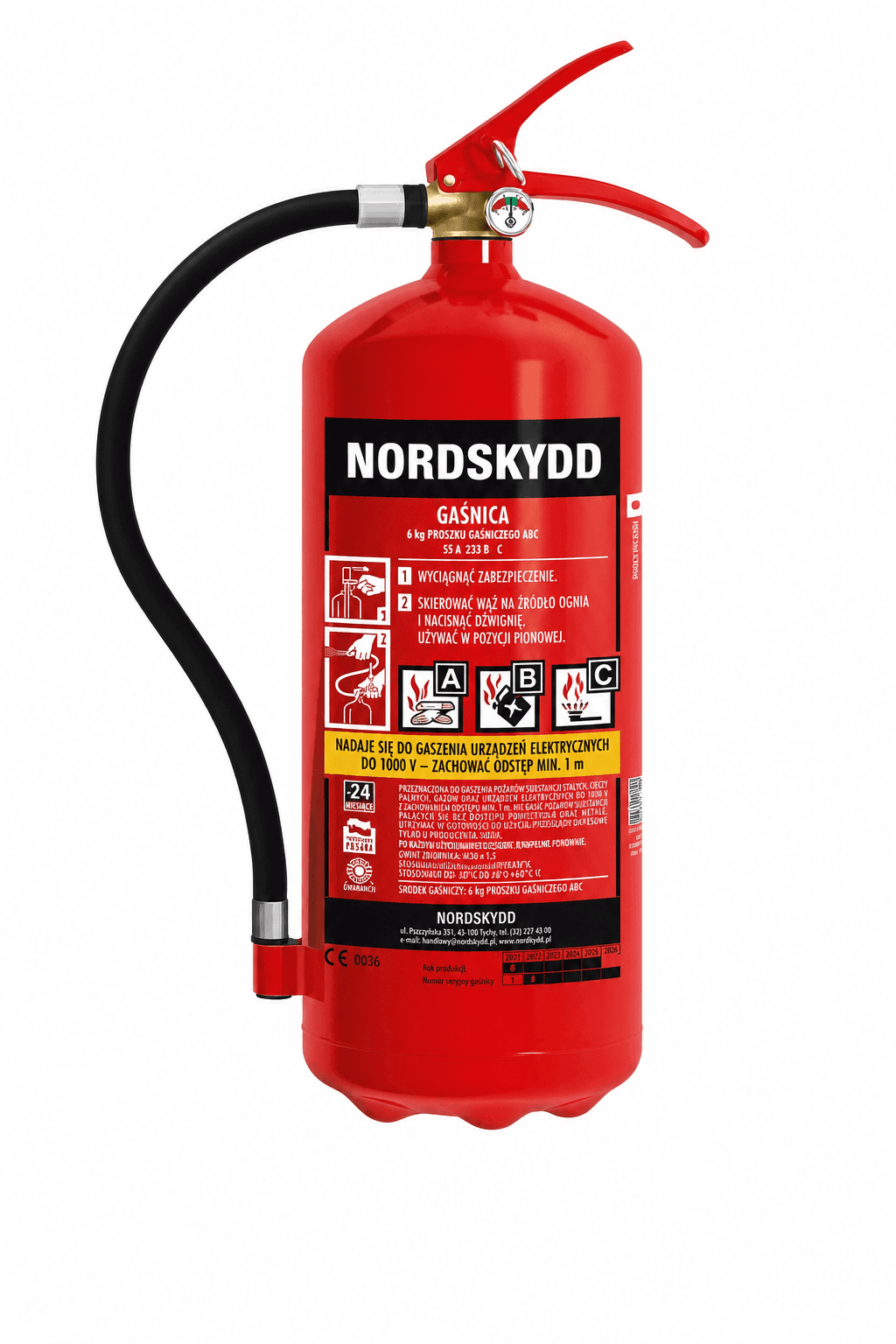
Our 6 kg ABC powder extinguisher is a typical workplace reference point: 6 kg ABC dry powder, 55A 233B C rating, EN 3-7, operating temperature from -30 °C to +60 °C, live equipment safety to 1000 V, metal hook wall hanger, 9.3 kg gross weight, 2-year warranty from date of manufacture, manufactured in Poland, article number NV-FE-106, CE, EN 3-7, CNBOP-PIB and ISO 9001, with HS code 8424.10 and EXW, FCA or DAP available.
Related equipment
ABC Powder Fire Extinguisher, 6 kg
Stored-pressure 6 kg ABC powder extinguisher rated 55A 233B C, supplied with a wall hanger for boiler rooms, garages, workshops, plant areas, and general commercial applications.
CE · EN 3-7 · CNBOP-PIB · ISO 9001
View specificationsThat specification makes powder a strong candidate for boiler rooms, workshops, garages, maintenance areas, fleet depots and other places where C-class gas suitability is required. Foam and water mist should not be substituted into a tender that explicitly asks for a C rating unless the fire-risk owner changes the requirement.
Smaller powder extinguishers answer a different need. A 1 kg ABC vehicle unit gives 8A 34B C cover in a 1.7 kg gross-weight product with a plastic vehicle hanger. A 2 kg ABC vehicle-format unit is rated 13A 89B C and has a 3.7 kg gross weight with a metal basket hanger. Those numbers affect boot kits, cabin mounting and carton planning.
The trade-off is discharge residue. Powder can spread beyond the seat of the fire, and the buyer should treat that as a cost if the location contains electronics, food handling surfaces, soft furnishings or customer-facing interiors.
When is foam the better specification?
Specify foam or liquid extinguishers when A and B cover is needed and the buyer wants less powder residue. Choose the exact foam type by fire rating, PFAS policy, F-class need and approval set.
For a PFAS-sensitive purchasing policy, our 6 L fluorine-free foam extinguisher uses 6 L FFX150 fluorine-free AB foam solution, is rated 27A 144B under EN 3-7, operates from 0 °C to +60 °C, has live equipment safety to 1000 V, includes a silver metal hook wall hanger, and is manufactured in Poland under article number NV-FE-L6F. Its certification set is CE, EN 3-7, CNBOP-PIB and ISO 9001.
That line fits offices, public buildings, workshops and facilities where a mid-size AB foam portable is needed without PFAS in the agent. For larger AB foam cover, the 9 L fluorine-free version is rated 34A 183B. For buyers tracking regulatory replacement planning, we maintain a separate guide to the EU PFAS ban for fire extinguishers.
ABF liquid is the foam-side choice when cooking-fat cover is mandatory. Our 2 L ABF liquid extinguisher is rated 8A 55B 40F, while the 6 L ABF liquid extinguisher is rated 21A 233B 40F. That F rating changes the use case: staff kitchens, residential kitchens, food retail back rooms and hospitality areas should not be treated as ordinary office fire points if cooking oils or fats are present.
Lithium-ion targeted foam products need separate checking. Our VER-DIS units are specified for lithium-ion battery incident contexts, but buyers should not treat “foam” as one interchangeable category. For example, the 2 L VER-DIS product facts state an 8A fire rating, CNBOP-PIB approval, PED 2014/68/EU, and not EN 3-7. If the tender requires EN 3-7, quote the SKU that actually carries that standard claim.
When does water mist make sense?
Specify water mist when the buyer wants a demineralized-water agent for A and F risks, with no powder discharge. It is not a like-for-like substitute for ABC powder where B or C cover is required.
Our 6 L water-mist extinguisher uses demineralized water, is rated 13A 40F under EN 3-7, operates from +5 °C to +60 °C, has live equipment safety to 1000 V at 1 m minimum, includes a metal hook wall hanger, and is manufactured in Poland under article number NV-FE-WM6. The certification set is CE, EN 3-7, CNBOP-PIB and ISO 9001.
This makes water mist a clean specification for living rooms, bedrooms, offices, accommodation projects and selected kitchen-adjacent points where the risk assessment calls for A and F cover. It also gives a clear message for housing providers and retail safety programmes: the agent is demineralized water, not powder and not foam concentrate.
The limitation is equally clear. The stated rating is 13A 40F. If your tender requires B-class liquid cover, compare foam or powder instead. If it requires C-class gas cover, compare powder. If the location is below +5 °C, do not force water mist into the specification without changing the environment or the requirement.
Send us the room type, minimum fire rating and destination country through our contact page if you want us to check whether water mist or ABF liquid is the cleaner fit for a housing or property-management order.
What is the minimum order and price context?
Our published product facts do not set a fixed MOQ for these extinguisher lines, so we quote after SKU mix, quantity, Incoterm and destination are confirmed. Price is driven by cylinder size, agent type, fire rating, certification set, mounting format, packaging requirement, order volume and freight boundary.
A 6 kg ABC powder unit, a 6 L fluorine-free foam unit and a 6 L water-mist unit may have similar cylinder dimensions in some cases, but they are not priced as the same product. The agent changes the bill of materials. The fire rating changes the tested specification. The approval set changes the documentation requirement. Gross weight affects freight planning.
Incoterm also changes the quote. Under EXW, the buyer arranges collection from the named place. Under FCA, the goods are handed to the carrier at the named place. Under DAP, we price delivery to the named destination, so we need the delivery address, unloading constraints and any booking requirements before quoting.
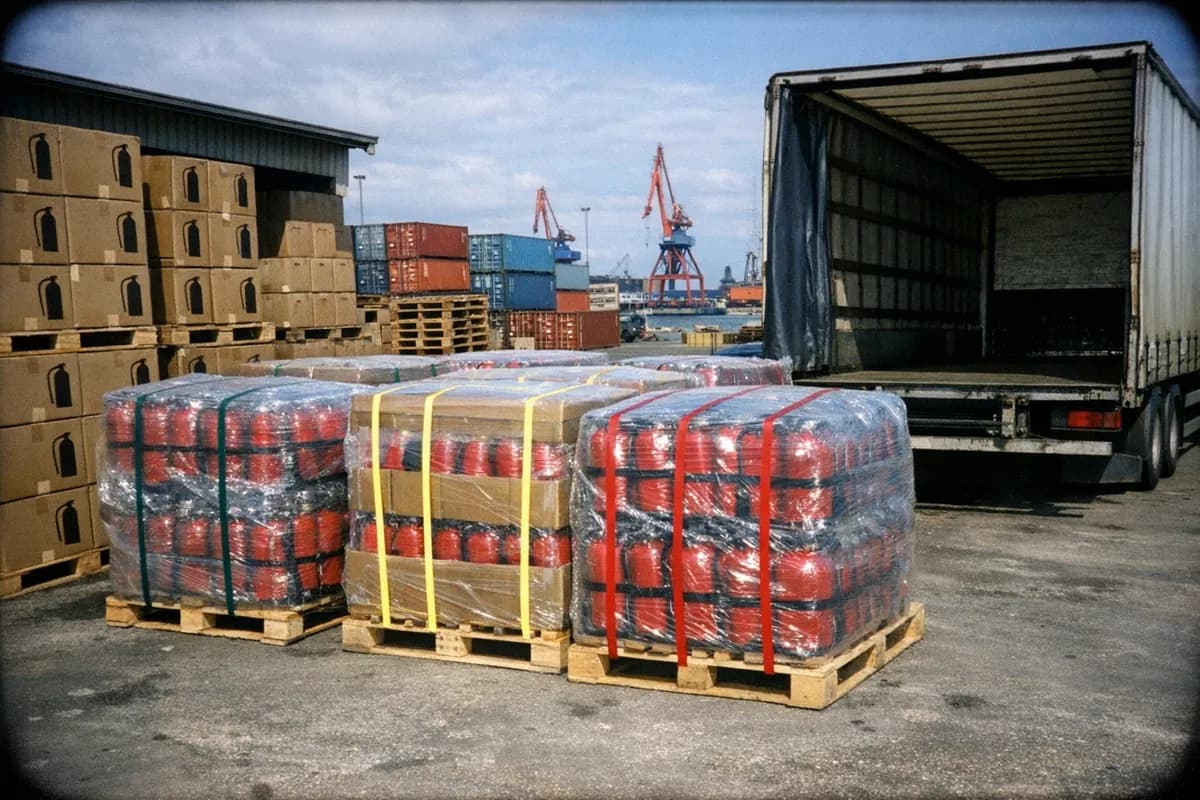
There is no useful terminal-market benchmark for a manufactured portable extinguisher that we would publish in a sourcing article. A current quotation is built from article numbers, confirmed quantity, packing, delivery term and route. If you already have target SKUs, send the list through our contact page for a current price.
How should the RFQ and order be written?
Write the RFQ by location, fire class, minimum rating, agent type, standard, certification requirement, mounting, quantity, Incoterm and destination. That prevents a generic “foam extinguisher” or “water extinguisher” request from being priced against the wrong SKU.
A clear powder line might read: “ABC powder extinguisher, EN 3-7, minimum 55A 233B C, wall hanger, CE, CNBOP-PIB, quantity by delivery point.” A foam line might read: “6 L fluorine-free AB foam, EN 3-7, minimum 27A 144B, PFAS-free agent required.” A water-mist line might read: “6 L water mist, demineralized water, EN 3-7, 13A 40F, wall hanger.”
For mixed orders, separate workplace extinguishers from domestic supplementary equipment and lithium-ion targeted products. The document set is SKU-specific. EN 3-7, CNBOP-PIB, ISO 9001, CE, PED 2014/68/EU and UDT permit do not apply uniformly across every extinguisher type in our range.
Use HS code 8424.10 for the extinguisher lines in our product facts. If the order also includes signs, fire blankets or vehicle first-aid kits, check those lines separately because their HS codes differ.
The best sourcing route is to decide the risk first, then the rating, then the agent. Powder is the broad A, B and C workhorse. Foam is the cleaner A and B option, with ABF or fluorine-free variants where required. Water mist is the demineralized-water choice for A and F points. Once that split is fixed, pricing and ordering become a controlled article-number exercise rather than a debate about extinguisher names.