Lithium-Ion Battery Fire Extinguishers: 2026 Checks
Lithium-Ion battery fire extinguishers need stricter SKU checks in 2026; this guide shows what to verify before quoting or ordering.
By Mattias EkstrandHead of Product and Trade SupplyFire protection engineer with fourteen years specifying fire safety equipment for EU trade buyers and procurement teams.
Lithium-ion battery fire extinguishers are not a single universal product category. For trade buyers, the safe way to buy in 2026 is to specify the exact extinguishing medium, certificate position, operating temperature, electrical safety statement, Incoterm, and intended resale channel before asking for a price.
We supply VER-DIS foam extinguishers positioned for lithium-ion battery fire risk, but we do not treat the word “lithium” as a substitute for documentation. A buyer should be able to match each SKU to a certificate file, a label requirement, a warehouse temperature range, and a freight plan before issuing a purchase order.
What should buyers check first in a lithium-ion battery fire extinguisher?
Check whether the product is actually specified for lithium-ion battery fire risk, then verify the certificate position and temperature limits. Do not buy only from a name such as “battery extinguisher” without matching the SKU to documents.
The first distinction is between an ordinary extinguisher and a product sold for lithium-ion risk. ABC powder, CO₂, water mist, ABF liquid, and foam products each have different use cases. A lithium-ion battery incident can involve heat, re-ignition risk, plastics, electrolyte, and surrounding Class A material. That does not mean every buyer needs the same cylinder size. It means the purchasing file must show why a particular agent and capacity were selected.
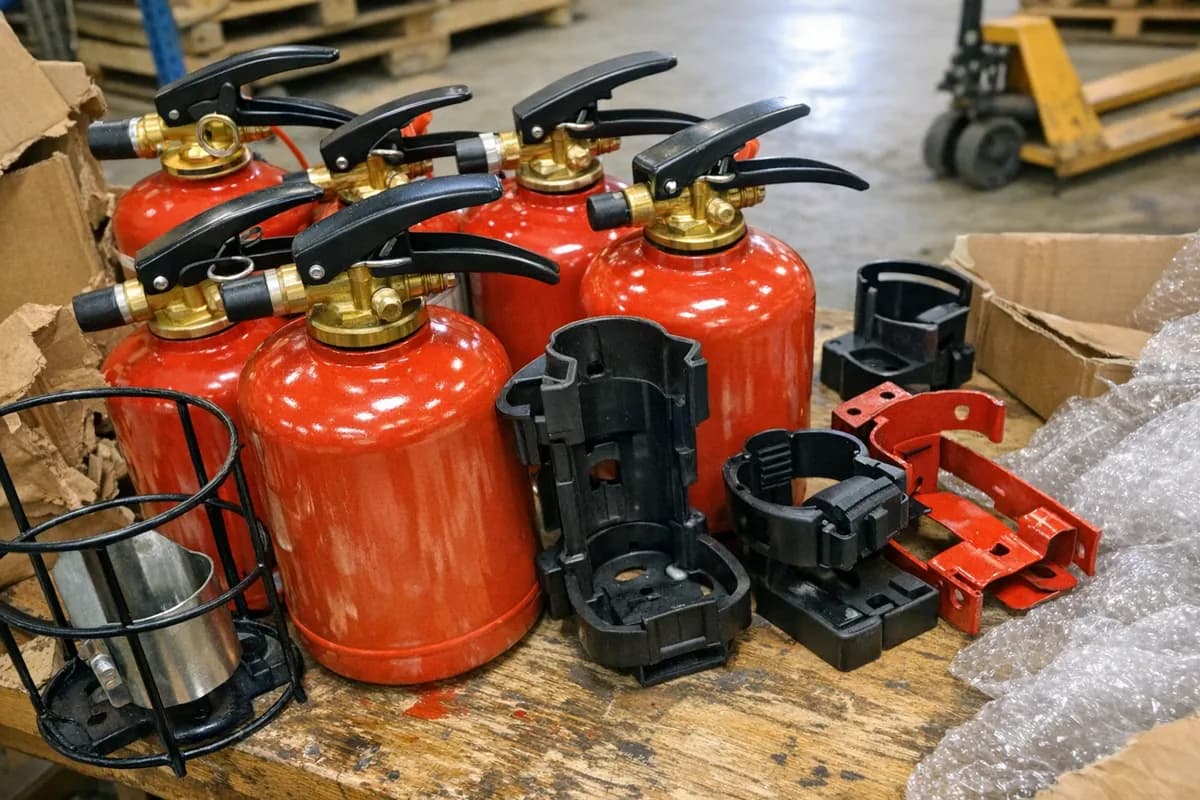
For our range, the lithium-ion relevant SKUs are VER-DIS foam extinguishers. They use VERDIS as the extinguishing medium and are separate from our ABC powder, CO₂, ABF, water-mist, and fluorine-free AB foam lines in the wider portable fire extinguishers range.
The second check is the rating language. The VER-DIS product facts show A-class fire ratings, not a battery pack size rating. Buyers should not convert an 8A, 21A, or 27A figure into an assumed lithium-ion battery capacity. Use the rating as a documented extinguisher field, then ask your fire risk assessor or local authority what performance evidence is acceptable for the actual site or resale market.
Temperature is the next practical filter. All three VER-DIS SKUs state +5 °C to +60 °C. If the intended storage point is an unheated van, an outdoor cabinet, or a warehouse zone that can fall below +5 °C, that must be dealt with before ordering. A product that is acceptable for an indoor battery-charging area may not be acceptable for a cold logistics bay.
Which VER-DIS lithium-ion extinguisher SKUs can be specified?
We currently list three VER-DIS foam extinguishers for lithium-ion battery fire risk: 2 L, 6 L, and 9 L. The buyer should select between them by capacity, mounting position, gross weight, and the certificate file required by the resale channel.
Our current VER-DIS specification set is as follows.
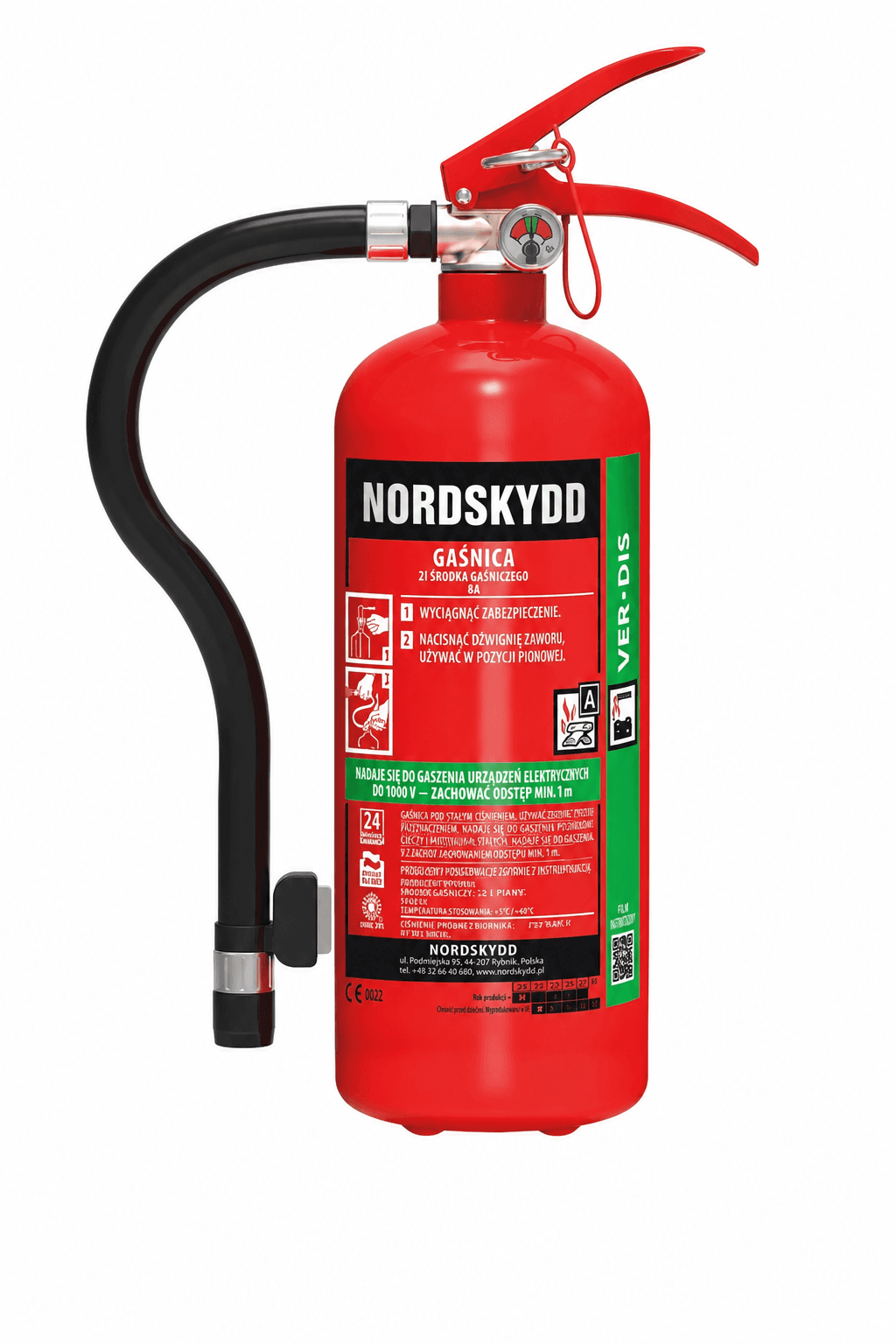
- The 2 L VER-DIS Li-Ion extinguisher is model GW-2x A/VER-DIS, article NV-FE-VD2, with 2 L VERDIS medium, 8A fire rating, CNBOP-PIB approval certificate, not EN 3-7, +5 °C to +60 °C operating temperature, live equipment safety to 1000 V at 1 m minimum, 368 mm height, 110 mm cylinder diameter, approximately 3.6 kg gross weight, red cylinder, red metal basket wall hanger, 2-year warranty from date of manufacture, manufactured in Poland, CE, CNBOP-PIB, ISO 9001, PED 2014/68/EU, HS code 8424.10, and EXW, FCA, or DAP Incoterms.
- The 6 L VER-DIS lithium-ion extinguisher is model GW-6x A/VER-DIS, article NV-FE-VD6, with 6 L VERDIS medium, 21A fire rating, CNBOP-PIB approval certificate issued, not listed as EN 3-7, +5 °C to +60 °C operating temperature, live equipment safety to 1000 V at 1 m minimum, 502 mm height, 160 mm cylinder diameter, 11.5 kg gross weight, red cylinder with black base and hose, silver metal hook wall hanger, 2-year warranty from date of manufacture, manufactured in Poland, CE, CNBOP-PIB, ISO 9001, PED 2014/68/EU, HS code 8424.10, and EXW, FCA, or DAP Incoterms.
- The 9 L VER-DIS Li-Ion extinguisher is model GW-9x A/VER-DIS, article NV-FE-VD9, with 9 L VERDIS medium, 27A fire rating, CNBOP-PIB approval certificate, not EN 3-7, +5 °C to +60 °C operating temperature, live equipment safety to 1000 V at 1 m minimum, 576 mm height, 185 mm cylinder diameter, 14 kg gross weight, red cylinder with black base and hose, silver metal hook wall hanger, 2-year warranty from date of manufacture, manufactured in Poland, CE, CNBOP-PIB, ISO 9001, PED 2014/68/EU, HS code 8424.10, and EXW, FCA, or DAP Incoterms.
Related equipment
Foam Fire Extinguisher, 2 L VER-DIS Li-Ion
Stored-pressure 2 L VERDIS foam cylinder rated 8A with CNBOP-PIB approval, for offices, living rooms, and bedrooms where lithium-ion battery fires on laptops, tablets, and powerbanks need controlled cooling without powder residue.
CE · CNBOP-PIB · ISO 9001 · PED 2014/68/EU
View specificationsFor a product review file, ask us for the article number you want to assess, then match that article number to your tender text or internal buying standard. If you need the product sheet before a price request, send the target market and SKU shortlist through our contact page.
Is EN 3-7 certification required for lithium-ion battery extinguishers?
Not always, but the buyer must know what the contract or local market requires. Our VER-DIS lithium-ion extinguisher product facts state CNBOP-PIB approval and also state that the 2 L and 9 L units are not EN 3-7, while the 6 L unit is listed with CNBOP-PIB approval certificate and not as an EN 3-7 extinguisher.
This matters because many procurement templates are written around EN 3-7 portable extinguishers. If a tender says “all portable extinguishers must be EN 3-7,” the VER-DIS line should not be inserted without clarification from the buyer’s authority, insurer, or fire consultant. A CNBOP-PIB approval certificate may be the required evidence in one channel, while another channel may insist on EN 3-7 wording.
We see this issue most often when a distributor wants one “battery extinguisher” SKU for multiple countries. That can work only if the compliance file is accepted in every market where the product will be sold. The label language, certificate references, warranty wording, and user instructions may also need review by the importer before sale.
For mixed ranges, keep the categories separate in your ERP and catalogue. A 6 kg ABC powder extinguisher in our range may be EN 3-7, while VER-DIS is a different compliance case. The same HS code does not mean the same standard position.
What is the MOQ and price context for lithium-ion battery fire extinguishers?
Our published product facts do not set a fixed MOQ for the VER-DIS lithium-ion extinguisher range, so we quote after the SKU mix, quantity, destination, and Incoterm are known. Send us the article numbers, order volume, delivery country, and preferred EXW, FCA, or DAP term for a current quotation.
Price is mainly affected by cylinder size, medium, certification set, hanger type, gross weight, order volume, and freight boundary. A 2 L unit with a basket hanger and a 9 L unit with hose and hook hanger do not create the same pallet weight or handling profile. DAP pricing also depends on the named destination, delivery access, and whether the shipment is groupage or a dedicated movement.
Do not compare lithium-ion extinguisher prices only by litres. A larger unit may have better coverage for a buyer’s risk assessment, but it also changes storage space, display cost, transport weight, and after-sales handling. A smaller unit may be easier for retail shelves or office wall points, but it may not match the buyer’s intended risk scenario.
We do not quote spot commodity-style prices for extinguishers because the cost build is SKU and freight dependent rather than a terminal market benchmark. The practical quote file should include article number, quantity, Incoterm, delivery country, requested document set, and any label or packing requirements from the buyer.
How should 2026 PFAS and agent checks be handled?
Treat PFAS status as a separate written check, not as something implied by “lithium-ion” or “foam.” Our VER-DIS product facts name the extinguishing medium as VERDIS, but they do not state fluorine-free, so a buyer that needs a PFAS position should request that evidence before ordering.
2026 matters because firefighting foam procurement in the EU is under closer chemical scrutiny. Commission Regulation (EU) 2024/2462 amends REACH Annex XVII for undecafluorohexanoic acid, PFHxA, its salts, and PFHxA-related substances, and includes 2026 application dates for certain fire-fighting foam uses. That regulation is separate from whether a product is suitable for lithium-ion battery risk.
A buyer should therefore run two checks in parallel. First, does the extinguisher meet the intended lithium-ion risk specification and certificate requirement? Second, does the agent chemistry meet the buyer’s PFAS policy, national rules, and customer tender wording?

If the buyer’s main driver is PFAS replacement rather than lithium-ion battery risk, the shortlist may be different. Our range includes fluorine-free AB foam products outside the VER-DIS line, and buyers comparing those routes can use our EU PFAS ban replacement guide before fixing the SKU.
How should buyers run the order from specification to delivery?
Run the order in a fixed sequence: risk definition, SKU selection, document check, quote, Incoterm, freight acceptance, then purchase order. That sequence reduces late changes after price agreement.
Start with the use case. A powerbank display, an office device-charging area, an e-bike service point, and a warehouse with battery-powered tools may not justify the same capacity. We cannot replace the buyer’s fire risk assessment, but we can keep the product selection tied to article numbers and documented specifications.
Next, confirm the compliance file. For VER-DIS, check CNBOP-PIB approval, CE, ISO 9001, PED 2014/68/EU, the stated non-EN 3-7 position, warranty period, and the +5 °C lower temperature limit. Ask internally whether the resale market accepts that combination before issuing a forecast.
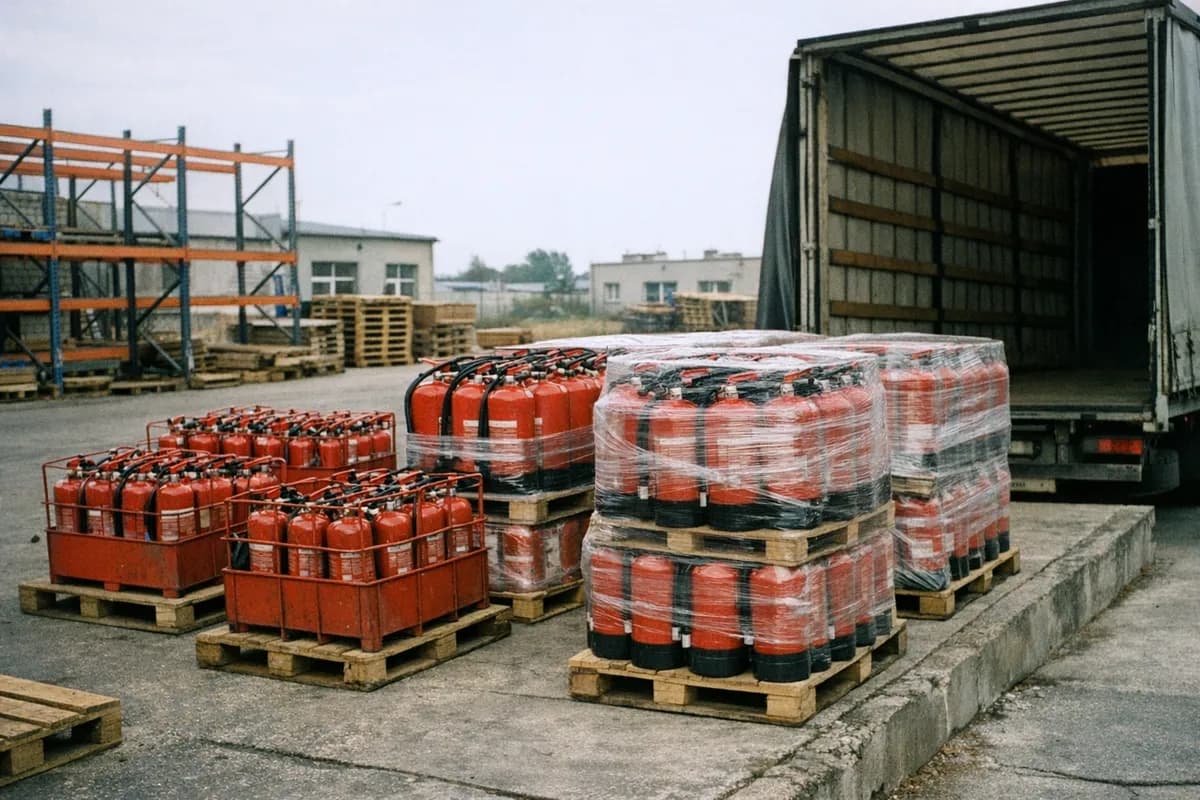
Then decide the Incoterm. Under EXW, the buyer controls collection. Under FCA, the handover point is agreed in the order. Under DAP, we need the delivery address and unloading details before quoting. The same extinguisher order can produce a different delivered cost under each term.
Finally, make the purchase order specific. Use article numbers, capacities, quantities, destination, Incoterm, required certificates, and any label review requirement. If your shortlist is ready, send those fields through our contact page and we will quote against the defined VER-DIS articles rather than a generic lithium-ion extinguisher description.